 Customer Support


07/02/2026
 If you sell to different customers at different prices, you already know how messy it can get.
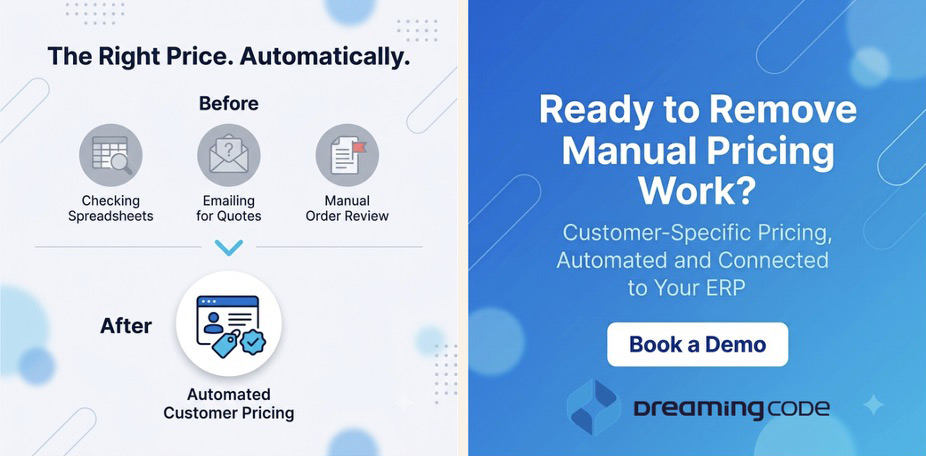
One customer has negotiated pricing. Another gets a volume discount. A distributor has access to one catalog, while a larger account has different payment terms. A regional buyer may only see certain products. Then someone from sales updates a spreadsheet, operations checks the ERP, and customer service tries to confirm which price is actually correct.
It works for a while.
Then the business grows.
Suddenly, customer-specific pricing becomes harder to manage. The same pricing questions keep coming back. Orders need extra review. Sales reps have to confirm discounts manually. Customers email for pricing instead of placing orders online. And your team spends valuable time doing work that should already be automated.
That is where customer-specific pricing ecommerce becomes important.
For manufacturers, distributors, wholesalers, and B2B sellers, pricing is rarely simple. Standard online pricing may work for consumer retail, but B2B commerce has more rules. The right customer needs to see the right products, the right pricing, and the right checkout options every time they log in.
The challenge is doing that without creating more manual work for your team.
Why Customer-Specific Pricing Gets Complicated
Many businesses start with a simple process.They keep pricing in spreadsheets. Sales reps know their accounts. Customer service checks past orders. Operations reviews special cases. Finance confirms payment terms when needed.
That can work when the customer base is small.
But as the business grows, the process starts to break down.
You may have different pricing by customer, contract, territory, order volume, product category, or distributor level. Some customers may pay by purchase order. Others may use credit cards. Some may only have access to certain products. Others may need approval before an order goes through.
Now imagine trying to manage all of that through email.
A customer requests pricing. A sales rep checks a spreadsheet. Someone confirms inventory. Another person checks the ERP. Then the customer receives a quote, but maybe the price has already changed.
It is slow. It creates room for mistakes. It also frustrates customers who expect a faster online buying experience.
This is why many B2B businesses eventually realize they do not just need an online store. They need a smarter pricing and ordering system.
What Customer Specific Pricing Ecommerce Really Means
Customer-specific pricing ecommerce means your online buying experience can show different prices, catalogs, and ordering options based on who is logged in.Instead of showing one public price to every buyer, your website can recognize the customer and apply the right rules automatically.
For example, a distributor may see negotiated wholesale pricing. A large enterprise account may see contract pricing. A regional buyer may only see products available in their location. A repeat customer may see frequently ordered items and simple reorder options.
This is where ecommerce price books become valuable.
Price books allow businesses to organize pricing by customer, segment, contract, or account type. Instead of forcing your team to remember every pricing exception, the platform handles the logic.
The customer logs in. The correct pricing appears. The order can move forward without someone manually checking every line item.
That is the kind of experience B2B buyers increasingly expect.
Manual Pricing Creates Hidden Costs
Manual pricing does not always look expensive at first.No one sees a line item called "pricing confusion" on the income statement. But the cost shows up in other ways.
Sales reps spend time answering repeat pricing questions instead of building relationships. Customer service gets pulled into order corrections. Operations have to fix errors after the fact. Finance has to resolve billing disputes. Customers wait longer than they should.
Even worse, pricing mistakes can hurt trust.
If a customer sees one price online, receives another price in an email, and gets invoiced for a third amount, they start to wonder what else is wrong.
For B2B companies, trust matters. A pricing error is not just an internal inconvenience. It can affect customer relationships, margins, and repeat business.
Automating the process helps reduce those risks.
How Automated Pricing Rules Reduce Manual Work
With automated pricing rules, your website can apply pricing logic based on customer data, account type, volume, product category, location, or contract terms.This removes the need for your team to manually review every order before the customer can buy.
For example, a wholesale customer logs in and sees wholesale pricing. A distributor sees a private product catalog. A sales rep places an order on behalf of a customer. A customer with credit terms checks out using a purchase order. A repeat buyer reorders from past purchases. A restricted product only appears for approved accounts.
These are practical improvements. They save time, but they also make the customer experience feel more professional.
Instead of waiting for a quote or emailing back and forth, buyers can place orders when they are ready.
That can be a real advantage, especially when your competitors still rely on manual follow-up.
Why ERP Pricing Integration Matters
Pricing usually does not live only on the website.For many manufacturers, distributors, and wholesalers, pricing rules are stored in an ERP, accounting system, or internal business platform. That is why ERP pricing integration is so important.
If your website and ERP are disconnected, your team may still need to update prices in multiple places. That creates duplicate work and increases the chance of errors.
A better approach is to connect the systems so pricing, inventory, customer records, and order data can move together.
When the website reflects ERP pricing logic, customers can see accurate prices online. Orders can flow back into the ERP. Inventory can update more reliably. Teams can spend less time copying data between systems.
That connection is where the real value of customer-specific pricing ecommerce starts to show.
It is not just about displaying a different price. It is about making the whole order process smoother.
B2B Order Automation Improves the Entire Workflow
Pricing is only one part of the buying journey.Once the customer sees the right price, the order still needs to move through the business. That may include inventory checks, approvals, purchase orders, payment terms, warehouse routing, fulfillment, notifications, and reporting.
B2B order automation helps connect those steps.
Instead of a team member manually reviewing every order, the platform can apply rules and route information where it needs to go.
For example, an order can be split between warehouses. A purchase order can be attached to the account. A sales rep can receive a notification. The ERP can update automatically. The customer can receive confirmation without waiting for someone to send it manually.
This is where Dreaming Code helps B2B companies turn pricing complexity into a cleaner online buying experience. Through its B2B eCommerce platform, Dreaming Code can support customer-specific catalogs, private price books, account-based permissions, purchase order checkout, reorder tools, and custom customer portals.
And through its integration services, Dreaming Code can help connect your website with ERP, CRM, inventory, accounting, fulfillment, and other business systems.
For business owners, operations leaders, and sales teams, this can be a major shift. The website becomes more than a storefront. It becomes a connected business tool that supports pricing, ordering, service, and growth.
With Radical Support, Dreaming Code also helps manage, monitor, and improve the platform over time, so the system can keep evolving as your business changes.
This is not about replacing your team. It is about giving them better tools.
Your people should not have to spend their day copying orders, checking spreadsheets, and chasing approvals. They should be helping customers, improving relationships, and growing the business.
Small Pricing Fixes Can Create Big Operational Wins
You do not always need to rebuild everything at once.Sometimes the best first step is identifying where pricing slows the business down.
Where does your team still rely on spreadsheets? Which customers require manual approvals? Which orders need review before they can move forward? Where do pricing mistakes happen most often?
Once you know where the friction lives, you can start building a better workflow.
Customer-specific pricing is not just a technical feature. It is an operational improvement. Done well, it saves time, reduces mistakes, improves customer experience, and helps your team scale without adding unnecessary complexity.
That is the real value of customer-specific pricing ecommerce.
Ready to Remove Manual Pricing Work?
Your customers should not have to wait for pricing confirmation every time they want to place an order.And your team should not have to manage every pricing exception by hand.
Dreaming Code helps manufacturers, distributors, wholesalers, and B2B sellers build connected ecommerce platforms that support customer-specific pricing, price books, ERP integration, order automation, and ongoing management.
If pricing has become too manual, too slow, or too hard to manage, it may be time to rethink how your website supports the business.
You can book a demo to see how Dreaming Code can help turn complex pricing into a cleaner, more scalable online buying experience.