 Customer Support


07/19/2026
 If you're like most business owners, you probably think about your website and email as two separate things.
Your website is where customers learn about you, submit forms, request quotes, book appointments, or place orders. Your email is where your team communicates, sends documents, follows up with leads, and manages daily work.
Different tools. Different vendors. Different problems.
At least, that is how it feels.
But from a security standpoint, your website and email are closely connected. A weak point in one can create risk for the other. A compromised website can damage customer trust. A phishing email can impersonate your brand. A domain issue can affect both your website and your email delivery.
That is why Managed website and email security matters for small and mid-sized businesses.
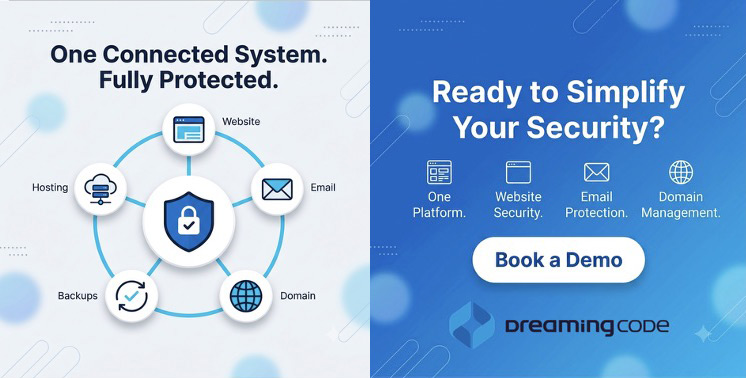
Your digital presence is not just your website. It is your site, email, domain, hosting, forms, backups, monitoring, and support all working together. When those pieces are managed separately, gaps appear. And those gaps can create real business risk.
At Dreaming Code, we see this often. A business has one company hosting the website, another provider managing email, someone else handling domain settings, and maybe a freelancer helping with updates. Everyone owns a piece, but nobody owns the full picture.
That is where problems start.
Why Separate Vendors Create Security Gaps
Many businesses do not choose a disconnected setup on purpose. It just happens over time.Maybe the website was built five years ago. Then the email moved to another provider. Then a marketing agency added forms. Then someone else set up a domain record. Later, a plugin broke, a backup failed, or a suspicious email made it through.
No single decision felt risky at the time.
But together, the setup becomes hard to manage.
When website hosting, email security, domain settings, backups, and support are spread across different vendors, it becomes harder to answer basic questions.
Who is monitoring the website?
Who is responsible if the site goes down?
Who checks for malware?
Who manages the domain records that affect email delivery?
Who confirms that backups are actually working?
Who helps when a customer receives a suspicious email that appears to come from your business?
That confusion wastes time. It also creates exposure.
For SMBs, this is especially challenging because most do not have a full internal IT team watching every detail. Business owners and office managers are often left coordinating between vendors, forwarding support tickets, and trying to figure out who is responsible.
That is not a security strategy. That is a scramble.
Managed Website and Email Security Protects Your Digital Front Door
Your website and email are often the first places customers interact with your business.Someone visits your website and submits a contact form. A prospect receives an email from your sales team. A customer clicks a link to pay an invoice, download a document, or schedule an appointment.
Each interaction depends on trust.
Managed website and email security helps protect that trust by managing the key parts of your digital presence together. That includes hosting, monitoring, backups, domain settings, email protection, threat prevention, and support.
Instead of treating each piece as a separate technical task, everything is managed as part of one connected environment.
That matters because attackers do not think in separate categories. They look for openings.
A weak password. An outdated website. A spoofed domain. A broken plugin. A fake login page. A phishing email that looks close enough to fool someone.
When the website and email environment are managed together, it becomes easier to spot issues, fix problems, and reduce risk before they turn into something bigger.
Secure Website Hosting Is Only One Piece
Secure website hosting is important, but it is not enough on its own.A properly managed website needs fast hosting, uptime monitoring, malware protection, SSL certificates, software updates, backups, and recovery planning. If your site goes down or gets infected, your business can lose leads, sales, and trust quickly.
But the website is only part of the risk.
Your email may be just as important, and in many cases, more exposed.
A phishing email can trick an employee into sharing credentials. A fake invoice can lead to payment fraud. A spoofed sender can make customers think a scam message came from your company.
That is why business email protection should be managed alongside the website.
The goal is not just to block threats. It is to protect your brand, your employees, your customers, and your daily operations.
Domain Security Connects Website and Email
Your domain is the foundation of your online identity.It powers your website address. It also supports your email addresses. If your domain settings are not configured correctly, it can affect search visibility, email delivery, security, and customer trust.
This is where domain security becomes very important.
For example, email authentication settings help confirm that messages from your domain are legitimate. Without the right setup, attackers may try to spoof your domain and send fake emails that look like they came from your business.
At the same time, DNS records control how your website loads, where traffic points, and how different services connect.
If domain settings are managed casually or by multiple disconnected vendors, mistakes can happen. Emails may go to spam. Website traffic may break. Security protections may be incomplete.
Most business owners do not want to manage DNS records, email authentication, SSL certificates, backups, and hosting settings. And they should not have to.
They need a partner that understands how those pieces work together.
Practical Examples of Connected Security Risks
Think about a medical practice with an outdated website and basic email protection.A patient submits a form through the site. The form sends information to a shared inbox. That inbox receives a phishing email that looks like a vendor invoice. Someone clicks it. Now the business has a website, email, and data security issue all at once.
Or consider a manufacturer that relies on email for customer quotes.
If an attacker spoofs the company domain, customers might receive fake payment instructions. Even if the website was never hacked, the brand still takes the hit.
Now think about a local service business.
The website goes down on a busy Monday morning. The hosting company says it is a domain issue. The domain provider says it is a DNS issue. The email provider says they only manage inboxes. Meanwhile, leads are not coming through, and nobody knows who owns the fix.
These are not dramatic edge cases. They are the kinds of everyday risks that happen when digital systems are managed in pieces.
Why Managed Website Support Matters
Security is not a one-time project.Your website changes. Your software changes. Threats change. Your team changes. Your business adds pages, forms, tools, plugins, campaigns, and integrations.
That is why managed website support is so important.
A secure site today may not stay secure if nobody maintains it. Backups need to be checked. Updates need to be handled carefully. Forms need to work. Monitoring needs to be active. Suspicious issues need fast attention.
Dreaming Code combines secure hosting, website monitoring, ongoing support, and Radical Support to help businesses avoid the common problem of having too many vendors and no single owner.
For business owners, that peace of mind matters.
Instead of wondering who to call when something breaks, you have a team that understands your website, your platform, your integrations, and your business goals.
Managed Website and Email Security Helps Reduce Business Risk
Most SMBs do not need enterprise complexity. They need practical protection that works.They need a website that stays online. Email systems that reduce phishing risk. Domain settings that are configured correctly. Backups that are ready when needed. Monitoring that catches problems early. Support that responds when something feels off.
Most of all, they need the full picture managed together.
That is the value of Managed website and email security.
It helps protect your digital presence as one connected business system instead of a collection of separate tools. It also makes it easier to keep your website performing, your email trusted, and your team focused on the work that actually grows the business.
Ready to Make Security Easier to Manage?
Your website and email should help your business run with confidence. They should not create confusion, risk, or another list of vendors to chase.Dreaming Code helps businesses manage hosting, security, monitoring, support, website performance, and connected digital systems through one managed platform.
If your website, email, domain, and support setup feel scattered, it may be time to simplify.
You can book a demo with Dreaming Code to see how a more connected approach can help protect your business and support long-term growth.