 Customer Support


Posts by Category

10/31/2024

Digital transformation and e-commerce are not just options —they are a necessity. Small and medium-sized businesses (SMBs) looking to expand their online presence often turn to platforms like Shopify. While Shopify is a popular choice, it may not fully cater to the unique requirements of many businesses. That's where custom eCommerce solutions for SMBs come into play, offering a more flexible, scalable alternative.
This blog explores why custom platforms can better serve small businesses, focusing on tailored integration, personalized experiences, and seamless growth. Discover why choosing custom eCommerce over Shopify might be the key to unlocking your business's full potential.
Why Choose Custom E-commerce Over Shopify for SMBs?
Shopify has become popular for many small businesses due to its perceived simplicity, ease of use, and array of templates. However, there may be better eCommerce platforms for small businesses with unique needs. For companies with complex workflows or specific industry requirements, off-the-shelf solutions like Shopify can be limiting, particularly regarding customization, integration, and scalability.Many SMBs need eCommerce solutions that integrate with existing systems such as ERP, CRM, and payment gateways. Custom platforms allow businesses to build a seamless, connected system, minimizing errors and manual tasks. Furthermore, as businesses grow, they often find that Shopify's functionality doesn't scale effectively, limiting their ability to expand and cater to more diverse customer needs.
Benefits of Custom E-commerce Solutions for SMBs
1. Seamless Integration with Existing SystemsA key advantage of customizable eCommerce software with ERP and CRM integration is connecting seamlessly with existing systems. This ensures that all parts of your business—from inventory management to customer data—are synchronized, creating a streamlined workflow. For SMBs handling complex product catalogs, integrated systems help to reduce manual work and minimize errors.
2. Scalability and Flexibility for Growing Businesses
Unlike standard platforms, scalable eCommerce solutions for growing SMBs can adapt as your business expands. Whether adding new product lines, entering new markets, or increasing your customer base, custom solutions grow alongside your business without limitations. This makes it easy for companies to scale operations without outgrowing their eCommerce platform.
3. Tailored Features and Custom Configurations
One of the significant benefits of custom eCommerce platforms for business growth is the ability to design features specific to your needs. It could be creating a unique checkout process, offering custom pricing, or supporting specialized product configurations; custom solutions can provide custom eCommerce features for unique product configurations. This allows businesses to deliver a more personalized customer experience, helping them stand out in a crowded market.
4. Enhanced Customer Experience
A full-service B2B eCommerce platform for small businesses enables SMBs to provide tailored customer experiences, from personalized product recommendations to custom catalogs and checkout processes. With tailored eCommerce platforms for B2B companies, businesses can offer differentiated services that build stronger relationships with their clients and improve overall satisfaction.
Choosing the Right Custom E-commerce Solution for Your SMB
When selecting a custom eCommerce platform, there are several factors to consider:>- Integration capabilities: Ensure the platform can connect seamlessly with your existing systems, such as ERP and CRM.
- Scalability: Look for a scalable eCommerce solution for growing SMBs that can grow alongside your business.
- Support and service: Choose a provider that offers ongoing support and expertise.
- Cost-effectiveness: Evaluate a custom solution's long-term benefits and cost savings compared to an off-the-shelf platform.
Conclusion
For SMBs with unique needs, custom eCommerce solutions provide the flexibility, integration, and scalability that off-the-shelf platforms like Shopify may need to improve. Custom solutions allow businesses to streamline operations, offer personalized customer experiences, and grow without constraints. If your business is looking for an eCommerce platform that goes beyond the basics, consider exploring full-service B2B eCommerce platforms tailored to your specific needs.Dreaming Code offers custom eCommerce solutions for SMBs to support small businesses with unique requirements. Our all-in-one SaaS platform integrates seamlessly with your existing systems, ensuring smooth, scalable growth—all for a simple monthly fee. Discover how DreamingCode can help you unlock your business's potential.

10/23/2024

In today's competitive B2B landscape, a one-size-fits-all eCommerce platform often falls short of meeting the unique needs of growing companies. B2B eCommerce requires complex workflows, custom pricing, and seamless integration with existing systems like ERP and CRM. For companies looking to scale and differentiate, customizable eCommerce solutions are essential. Let's explore why tailored platforms are critical for B2B businesses and how they can drive success.
1. Streamlined Operations Through Integration
One of the biggest challenges for B2B companies is managing complex back-office systems, such as inventory management, order processing, and customer data. Customizable eCommerce platforms enable seamless integration with existing systems like ERP, CRM, and accounting software, creating a more streamlined workflow. This reduces manual work and minimizes errors, helping businesses operate more efficiently.
For example, an eCommerce solution that integrates directly with a company's ERP can automatically update inventory levels and process orders in real-time. This level of automation is precious for B2B companies that handle large orders and manage extensive product catalogs. With other packaged solutions, companies often migrate all their systems or create duplicate versions to get the platform's benefits.
2. Tailored Customer Experiences
B2B transactions are inherently more complex from an ordering and fulfillment perspective. They often involve larger order volumes, custom pricing structures, and specific terms that differ from one client to another. A customizable eCommerce platform allows businesses to build tailored experiences that meet these unique requirements. This might include personalized catalogs, custom quotes, or negotiated pricing for different clients. By providing a user-friendly and customized purchasing experience, companies can strengthen customer relationships, improve satisfaction, and ultimately increase sales. Personalization is no longer a luxury; it's necessary for B2B companies that want to stand out in a crowded marketplace.
3. Scalability and Flexibility
As B2B companies grow, their eCommerce needs evolve. They might enter new markets, expand their product lines, or offer new services. Customizable eCommerce solutions provide the flexibility to adapt to these changes without requiring a complete system overhaul.
For example, adding new features like subscription models, bulk ordering capabilities, or a multilingual interface can seamlessly be done with a customized platform. This adaptability makes it easier for businesses to scale and grow without being limited by their technology stack. A rigid, out-of-the-box solution may struggle to accommodate these needs, hindering a company's growth potential.
4. Enhanced Data Insights and Analytics
Data helps businesses run more efficiently and perform better. B2B eCommerce platforms that can be tailored to the needs of a business also provide deeper insights into customer behavior. Companies can track how clients interact with the platform, which products they are most interested in, and where friction points in the buying process might occur.
These insights enable businesses to make data-driven decisions to improve their offerings and marketing strategies. Custom reports and dashboards can be created to give companies a clearer picture of their sales performance and help them identify areas for improvement.
Conclusion
For B2B companies looking to scale, a customizable eCommerce solution offers the flexibility, integration, and personalized customer experiences essential for success. Off-the-shelf platforms might be sufficient for smaller businesses or B2C environments, but they often need more depth and adaptability for B2B enterprises. By investing in a tailored solution, companies can streamline operations, build stronger customer relationships, and drive growth.
Dreaming Code Inc. is a partner who can drive your digital success. We provide an industry-leading platform to enable agile and flexible digital experiences. We also offer monthly content services to help you succeed at moving the performance of your digital solution. Our solution consultants are eager to support you in planning, building, and scaling your digital transformation. Schedule to meet us today!
To learn more about the Dreaming Code eCommerce platform visit: http://dreamingcode.com.

07/02/2020
Today traditional distributors find their industry rapidly changing, and the services they were once valued for no longer provide as competitive an advantage as they once did. As shopping carts become more virtual, and window shopping is replaced with browser screens the importance and need for B2B e-commerce becomes increasingly important.
Today's buyers are used to doing their own research and enjoy the quick availability of information from pricing, product delivery information, and product availability. It is important for wholesalers to have a stronger online presence in order to remain competitive.
As stated by Pepperi in 2020 article "If you haven't already invested in a B2B e-commerce platform, you're likely lagging behind your competition. According to a recent survey by Accenture, 86% of US-based B2B companies with over $500M in annual revenues have already implemented a B2B e-commerce solution."
Wholesalers should take note of this and use e-commerce platforms as a way to enhance and leverage their customer experience, tap into new markets and allow consumers to shop mobile.
Dreaming Code's B2B ecommerce solution can grow your business. Our platform allows you customers to view commonly placed orders with custom pricing all in one portal.
Today's buyers are used to doing their own research and enjoy the quick availability of information from pricing, product delivery information, and product availability. It is important for wholesalers to have a stronger online presence in order to remain competitive.
As stated by Pepperi in 2020 article "If you haven't already invested in a B2B e-commerce platform, you're likely lagging behind your competition. According to a recent survey by Accenture, 86% of US-based B2B companies with over $500M in annual revenues have already implemented a B2B e-commerce solution."
Wholesalers should take note of this and use e-commerce platforms as a way to enhance and leverage their customer experience, tap into new markets and allow consumers to shop mobile.
Dreaming Code's B2B ecommerce solution can grow your business. Our platform allows you customers to view commonly placed orders with custom pricing all in one portal.

03/28/2018
By 2020, it is predicted that business to business (B2B) eCommerce will completely eliminate the need for sales representatives at manufacturers, wholesalers and distributors, due to the steady rise of online ordering. These sales representatives are essentially becoming useless in the ordering process. In fact, as stated by Forrester's "Death of a (B2B) Salesman," it is predicted that roughly one million B2B sales reps will lose their jobs by 2020.
Based on this, it is nearly inevitable that all industries will embrace B2B eCommerce; it is just a matter of when. And, as industries progressively implement B2B eCommerce, the significance of sales representatives steadily declines. However, just like anything else in business, with every threat comes an opportunity. What if sales representatives were given the ability to seamlessly grant clients access to your company's products and inventory? This would give these sales representatives a purpose and allow them to make commission from the sales that result from this. To top it off, giving customers access to a personalized wholesale shopping experience would make large B2B orders easier than ever.
With DreamingCode's Commerce Platform, each customer that is able to access your inventory will have custom pricing for their specific profiles and accounts. Some customers need more from you, some need less. Regardless, authenticated accounts can simply log in to the B2B portal of the business, check the inventory to see what is available, and place their order based on the custom pricing that you set up for them. In the end, not only does this simplify the ordering process, but it helps combat the rapidly increasing number of sales reps that are losing their jobs.
Based on this, it is nearly inevitable that all industries will embrace B2B eCommerce; it is just a matter of when. And, as industries progressively implement B2B eCommerce, the significance of sales representatives steadily declines. However, just like anything else in business, with every threat comes an opportunity. What if sales representatives were given the ability to seamlessly grant clients access to your company's products and inventory? This would give these sales representatives a purpose and allow them to make commission from the sales that result from this. To top it off, giving customers access to a personalized wholesale shopping experience would make large B2B orders easier than ever.
With DreamingCode's Commerce Platform, each customer that is able to access your inventory will have custom pricing for their specific profiles and accounts. Some customers need more from you, some need less. Regardless, authenticated accounts can simply log in to the B2B portal of the business, check the inventory to see what is available, and place their order based on the custom pricing that you set up for them. In the end, not only does this simplify the ordering process, but it helps combat the rapidly increasing number of sales reps that are losing their jobs.

07/08/2016
eCommerce doesn't always mean there is a credit card on file or that you have to decide between priority and ground shipping. The purpose of B2B commerce is enabling other businesses or your partners to access inventory, past orders, credit terms, or any other kind of electronic transaction that may occur between your company and another.
Oracle White Paper survey on B2B eCommerce showed that there is 50 percent more revenue in B2B commerce than B2C, and that's with only 25 percent of B2B companies having online commerce sites.
DreamingCode recently launched an eCommerce site for Sukesha All-Nutrient Hair Color, but not so the public can order hair color tools from the company. This B2B site allows approved salons and partners to have access to inventory and other services.
Sukesha wanted to put in place online commerce to provide an Apple or Amazon like experience for salons and partners to make any transaction easier and more accessible to other businesses. But B2B eCommerce also makes things easier for the distributor.
Sukesha used DreamingCode to create their own personalized B2B eCommerce platform to specifically cater to the statistics, consumer portfolio information, and order information that they need in their industry.
B2B eCommerce can be utilized by any service or product provider. The new trend is to make the platform customized for your industry, like Sukesha has.


06/08/2016
Companies like Kindle and Nook have used their platforms on Amazon and Barnes & Noble to promote daily deals on books for 24 hours for as low as $1.99. As a result, they have seen instant sales boosts and wider exposure for the author.
However, other online stores have remained skeptical. Recently, the New York Times, Social Media Examiner and Warc have researched this subject with the wider marketing community, finding that these 24-hour sales make the product "almost irresistible."
While these low prices make it difficult to make a large profit from the sales, this marketing tactic introduces new products to the consumer without making them feel like they are investing in something they might have not really been looking for.
In recent studies social media marketers have indicated that social media tools like Groupon and LivingSocial were at the bottom of their marketing mix for the near future.
For new online products or products that have been low in sales, your eCommerce store may benefit from these short sales if marketed correctly.
Information about the sale should be announced via email blast as well as social media.
For the consumer, it's a low risk buy. Make it cool. Make it new. And, make it interesting.
However, other online stores have remained skeptical. Recently, the New York Times, Social Media Examiner and Warc have researched this subject with the wider marketing community, finding that these 24-hour sales make the product "almost irresistible."
While these low prices make it difficult to make a large profit from the sales, this marketing tactic introduces new products to the consumer without making them feel like they are investing in something they might have not really been looking for.
In recent studies social media marketers have indicated that social media tools like Groupon and LivingSocial were at the bottom of their marketing mix for the near future.
For new online products or products that have been low in sales, your eCommerce store may benefit from these short sales if marketed correctly.
Information about the sale should be announced via email blast as well as social media.
For the consumer, it's a low risk buy. Make it cool. Make it new. And, make it interesting.

06/03/2016
It's true. Businesses are spending more of their budgets making online purchases, but is it possible that they would be interested in spending even more online?
Acquity's "2013 State of B-to-B Procurement Study" conducted in March and April has found that B2B buyers would be even more likely to make purchases online if the search technology and purchasing process were easier to navigate.
According to the report, 37% of those surveyed plan to increase their spending online in the next year, including on technology.
"B2B suppliers have a significant opportunity to increase their revenue from e-commerce," said Robert Barr, senior VP at Acquity Group according to B to B Online. "Our study revealed corporate buyers are comfortable and willing to make major purchases online—and many are already doing this—but not on suppliers' websites."
Other major factors to encourage purchases of $5,000 or more online are increased security, free delivery, available customer service reps by phone, customer service online chat features, faster delivery, friendlier design, and better online research sources.
In addition to these features, 28% of those surveyed said that they would make purchases on their mobile devices if suppliers offered easier to use, mobile optimized sites.
If your B2B eCommerce site doesn't have the capability to make some of these changes, It might be time for a eCommerce platform facelift according to these findings.
Acquity's "2013 State of B-to-B Procurement Study" conducted in March and April has found that B2B buyers would be even more likely to make purchases online if the search technology and purchasing process were easier to navigate.
According to the report, 37% of those surveyed plan to increase their spending online in the next year, including on technology.
"B2B suppliers have a significant opportunity to increase their revenue from e-commerce," said Robert Barr, senior VP at Acquity Group according to B to B Online. "Our study revealed corporate buyers are comfortable and willing to make major purchases online—and many are already doing this—but not on suppliers' websites."
Other major factors to encourage purchases of $5,000 or more online are increased security, free delivery, available customer service reps by phone, customer service online chat features, faster delivery, friendlier design, and better online research sources.
In addition to these features, 28% of those surveyed said that they would make purchases on their mobile devices if suppliers offered easier to use, mobile optimized sites.
If your B2B eCommerce site doesn't have the capability to make some of these changes, It might be time for a eCommerce platform facelift according to these findings.

05/24/2016
Retail companies with aggressive e-commerce strategies are growing at a rapid rate. While Internet retailing only accounted for 11% of total apparel sales in North America during 2014, this will soon change as e-commerce, S-commerce (social media commerce) and M-commerce (mobile-commerce) explode.
Let's define e-commerce as somewhere where data meets marketing to achieve customer acquisition and satisfaction. Nowadays, consumers want to find what they want in a matter of seconds, and a company that knows how to reach them effectively through e-commerce is way above every other.
How should an e-commerce team be composed?
E-commerce selling tactics: Lessons from successful companies
1. Personalization/Data-driven selling
Amazon, Netflix, and Nordstrom
Amazon and Netflix are the forerunners of personalization. They can use data to know what customers like, dislike, track their cookies to identify what a customer has searched for, bought in the past, cart abandonment rate, where they are located, when and where they're connecting to the internet, whether they use Windows or MAC, how often they purchase online and a complete history of their purchases. Based on this, they personalize customers' experience and Up-sell. The magic with this tactic is being able to change the algorithm and do AB testing until you acquire the customer. For example, if a customer searched for a specific shoe model, he or she will probably be interested in seeing a similar model. This also occurs when a customer searches for a movie on Netflix, and is more inclined to continue watching when provided with all of the movie options from that genre.
How to use customers' information? Once the user's cookies have been tracked, the company could send him/her recommendations of similar products, if a customer abandons the purchase for a specific product, the retail company could send him/her a personalized coupon to complete the purchase, or propose complements and gear that would go well with that last purchase. There are thousands of ways to play with filters and to do AB testing to keep the customer engaged.
Nordstrom is a company that has taken personalization above and beyond. They personalize a customer's page, which means my Nordstrom page will look completely different from my neighbor's page. They track customer's cookies and every time the customer goes to the site they get smarter and the process is much more personalized.
2. Subscription model
STITCH FIX and BIRCHBOX
Stitch Fix and Birchbox are 2 companies that are constantly trying to drive repeat visits to their site. Stitch Fix offers a free consultation service with the creation of a subscription. The process begins by asking women for every detail from their measurements, to dress size, occupation and most common outfits. The key is the form is quick and easy to complete. Stitch Fix offers fixed style options where customers' only task is to grade from like to dislike, or select among 4 dress occasions such as casual/night out/business or cocktail. This way customers have closed options, they don't have to spend lots of time filling the subscription, and Stitch Fix can retrieve valuable customer information in a matter of seconds.
After the subscription is created, the stylist chooses different styles of clothing based on the aforementioned categories and the products are shipped to the customer's door. She can go through everything and return whatever she doesn't like. The process allows Stitch Fix to learn a customer's likes and dislikes and offer more accurate recommendations every time.
Birchbox is another company that has taken subscriptions to another level. Similar to Stitch Fix, they offer a subscription for customers to test the latest beauty products, with the option to buy the retailer size. What's to love about Birchbox? It's similar to Sephora's culture of offering women the advantage of trying products in store before they buy, except Birchbox delivers 4-5 monthly samples to the customer's home. Like Stich Fix, Birchbox is based on the customer's preferences; it gets smarter every time and offers better and more accurate recommendations to their customers while offering the possibility to try beforehand.
So how could a company create effective subscription models and recommend personalized products for its brands? An idea for shoe brands could involve tracking the amount of miles a user has put on his/her shoes, and contact the customer when it's time to purchase a new model, sending that specific customer a brochure with coupons for the next top model and the option to order it online. As Boston is well known for the Boston Marathon, another option would be putting together personalized packages for runners with recommendations and giving them the advantage of trying products.
3. Experts/personal shopping:
Backcountry
Having a celebrity endorse your brand may be a good idea if you have the right person to do it. However, a more economical way and even more engaging way to go is having different experts blog about real experiences they've had while using the brand's products, and offering a forum where these experts can connect with your customers to offer them advice and recommendations.
Backcountry, the online specialty retailer, sells gear for outdoor activities such as hiking, camping, rock climbing, ice climbing, skiing and other outdoor activities. What they've done is create advocates for their brand and allow their customers to engage and chat with these advocates. Every customer can follow his/her own Gearhead depending on their interests (hiking, running, golfing, skiing, etc). The Gearhead is a real person that writes about his/her experiences as a blogger and gives his/her honest opinion regarding different products. A customer can chat with a Gearhead, ask about products and ask for advice. Also, the Gearhead will get to know the customer and what type of products he/she likes.
The new thing about this is Backcountry is allowing customers to interact in real time with pros who are actually using these products to go on adventures and offering honest opinions.

Some of the Gearheads of Backcountry. Source: Backcountry's web site
J CREW is another company that succeeds at personal shopping. A customer can book an appointment with a personal shopper who will show him products, ideas to create outfits, and what they're doing is developing a personal relationship with customers.
4. Content
Lululemon
One of the main problems about shopping online is customers are unsure whether the product will look the same in real life, or maybe they're concerned the sizes are different and may not fit. Here is where the brand has to make it as easy as possible so customers complete purchases.
Lululemon has done a great job showing the features of their products and ensuring customers know the value of the product they are purchasing. Let's say a customer goes online and sees a $150 bag. They always show specifications, high quality photos of the product, every detail that convinces the customer the product is worth it. They also show why they made that product, fabric and features, fit and function and extra features to help convert customers.
If the company's product has a price point slightly above competition, showing the extra value a customer is getting is essential. Videos and pictures are 2 great conversion points for consumers, taking great pictures for high-quality and high-price products may be the conversion for the customer. Also, allowing the customer to see every detail of the product, for example, highlight the value added-features, such as the gel arch support of emphasize the domestic manufacturing and craftsmanship dedication of every product.
5. The showroom trend.
Bonobos
Showrooming is a concept U.S. companies haven't quite grasped, but Europe has and they're succeeding at it. A big barrier for shopping online is not being able to try on the product. So either the brand creates an excellent size/fit assistance online tool so women's fear of purchasing online diminishes, or the company creates showrooms offering women the same competitive price and convenience online retailing can offer.
A second reason to start with showrooms is the increase of mobile commerce. In Western Europe, mobile internet retailing increased by a CAGR of 102% from 2011 to 2014, thanks to the showrooming trend. As more customers switch to mobile commerce in the U.S. showrooms may be the answer.
Of course, companies are worried that consumers won't go for this since 73% of consumers are motivated to shop in store by the desire of an instant purchase. However, when it comes to high quality, sports footwear where the customer may want to try the product, feel the quality, evaluate a product they'll use in their everyday roughtine, they'll surely be willing to try it in store.
If the company's products are domestically sold and made in the U.S., they could set a showroom near their facility and deliver to houses, while avoiding costs of sales assistance, huge inventory in every store and a much more personal relationship with the customer. Recreational shopping would continue to exist, since customers will be able to have the products in their hands, the only thing that would be change is where the transaction is being made.
An example of said success is Bonobos, the e-commerce business that is following the showroom trend, and the success is eminent. This company redefined the traditional retail format by venturing offline into physical stores with one difference, nothing to sell in the store. They have showrooms and allow customers to try on items, evaluate the quality, and place orders that will be delivered to their front door, while eliminating the cost of storing huge inventory and freeing sales assistants to focus solely on the customer.
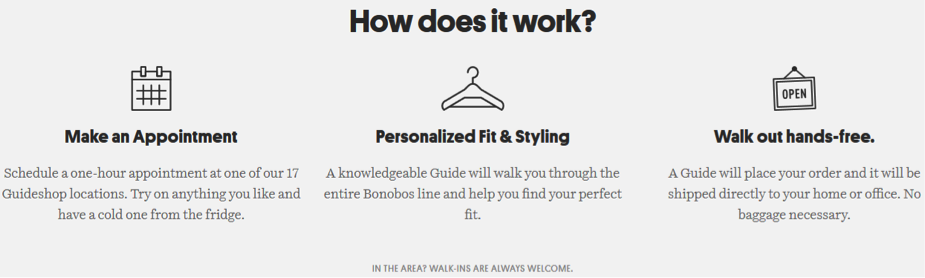
From: Bonobos site.
These 5 tactics can be combined to develop one strong e-commerce strategy.
Mobile commerce and social media commerce are also something to watch. Some companies have started taking action. Myntra, the e-commerce site owned by Flipkart has just announced closing their site and moving exclusively to mobile. Other e-commerce monsters such as Alibaba and TaoBao may follow. Regarding social media commerce, according to Euromonitor, 43% of consumers around the world make purchases through social media, however 11% to 15% of consumers use s-commerce in the US and UK respectively.
Any retail company can use these strategies at the right time to innovate themselves and leave competitors behind in the e-commerce revolution.
Let's define e-commerce as somewhere where data meets marketing to achieve customer acquisition and satisfaction. Nowadays, consumers want to find what they want in a matter of seconds, and a company that knows how to reach them effectively through e-commerce is way above every other.
How should an e-commerce team be composed?
- Finance: A finance team that makes sure e-commerce strategies are generating profits to boost the company's growth and create a positive ROMI.
- Marketing: A brand marketing team that will propose customer acquisition tactics and continuously focus on driving traffic to the site. Specifics include SEO, optimize paid, earned and owned media, retention marketing strategies, creating appealing stories and new possible products for the company.
- Analytics team: Every marketing effort should be measured with marketing analytics tools and KPI's to see which strategy worked best, which products are best-sellers, understanding which factors drive customers to purchase, or how and where to target a specific customer. Some specific metrics the team would deliver: Percentage of sales from Mobile/Social, New Visitor Conversion Rate, Average Order Value, CPC, Churn Rate, Cart Abandonment Rate and Customer Lifetime Value.
- Customer service: Companies that are constantly listening to their customers are extremely successful. It is cheaper to maintain a customer than to acquire one, which is why resolving customers' issues and giving excellent customer service is essential.
- Merchandising/planning: Understanding which of the products will be best sold on the website and knowing when and which new products to launch. Also, teams can use analytics to see which products are the most searched and this could turn into product innovation. If the company is not carrying the product that's being searched for by customers, merchandising could approach the product development team with ideas to develop new ones. This team will not only manage the merchandise on site but will be essential to identify opportunities for the company. They have to manage calendar, product launch, inventory, stories, make sure the content and benefits of each product are visible.
- Development: A team of coders to bring all ideas to life is always necessary. Having in-house coders would allow constant innovation of the site. If marketing wants to launch a video carousel or interactive visuals, coders can help with the task.
- User experience: A team that creates the path and the structure to navigate through the page. When customers go online they should be able to find what they want in a matter of seconds. The customer decision journey should be smooth and comprehensible in order for the customer to complete the purchase and return. This team may perform AB testing to select the best user experience. For example: show customers 2 different paths and allow them them to select the one they prefer.
- Creative: When customers land on the company web page they should immediately feel related to the brand. This team makes sure imagery, fonts, videos and the entire look represent the company culture.
E-commerce selling tactics: Lessons from successful companies
1. Personalization/Data-driven selling
Amazon, Netflix, and Nordstrom
Amazon and Netflix are the forerunners of personalization. They can use data to know what customers like, dislike, track their cookies to identify what a customer has searched for, bought in the past, cart abandonment rate, where they are located, when and where they're connecting to the internet, whether they use Windows or MAC, how often they purchase online and a complete history of their purchases. Based on this, they personalize customers' experience and Up-sell. The magic with this tactic is being able to change the algorithm and do AB testing until you acquire the customer. For example, if a customer searched for a specific shoe model, he or she will probably be interested in seeing a similar model. This also occurs when a customer searches for a movie on Netflix, and is more inclined to continue watching when provided with all of the movie options from that genre.
How to use customers' information? Once the user's cookies have been tracked, the company could send him/her recommendations of similar products, if a customer abandons the purchase for a specific product, the retail company could send him/her a personalized coupon to complete the purchase, or propose complements and gear that would go well with that last purchase. There are thousands of ways to play with filters and to do AB testing to keep the customer engaged.
Nordstrom is a company that has taken personalization above and beyond. They personalize a customer's page, which means my Nordstrom page will look completely different from my neighbor's page. They track customer's cookies and every time the customer goes to the site they get smarter and the process is much more personalized.
2. Subscription model
STITCH FIX and BIRCHBOX
Stitch Fix and Birchbox are 2 companies that are constantly trying to drive repeat visits to their site. Stitch Fix offers a free consultation service with the creation of a subscription. The process begins by asking women for every detail from their measurements, to dress size, occupation and most common outfits. The key is the form is quick and easy to complete. Stitch Fix offers fixed style options where customers' only task is to grade from like to dislike, or select among 4 dress occasions such as casual/night out/business or cocktail. This way customers have closed options, they don't have to spend lots of time filling the subscription, and Stitch Fix can retrieve valuable customer information in a matter of seconds.
After the subscription is created, the stylist chooses different styles of clothing based on the aforementioned categories and the products are shipped to the customer's door. She can go through everything and return whatever she doesn't like. The process allows Stitch Fix to learn a customer's likes and dislikes and offer more accurate recommendations every time.
Birchbox is another company that has taken subscriptions to another level. Similar to Stitch Fix, they offer a subscription for customers to test the latest beauty products, with the option to buy the retailer size. What's to love about Birchbox? It's similar to Sephora's culture of offering women the advantage of trying products in store before they buy, except Birchbox delivers 4-5 monthly samples to the customer's home. Like Stich Fix, Birchbox is based on the customer's preferences; it gets smarter every time and offers better and more accurate recommendations to their customers while offering the possibility to try beforehand.
So how could a company create effective subscription models and recommend personalized products for its brands? An idea for shoe brands could involve tracking the amount of miles a user has put on his/her shoes, and contact the customer when it's time to purchase a new model, sending that specific customer a brochure with coupons for the next top model and the option to order it online. As Boston is well known for the Boston Marathon, another option would be putting together personalized packages for runners with recommendations and giving them the advantage of trying products.
3. Experts/personal shopping:
Backcountry
Having a celebrity endorse your brand may be a good idea if you have the right person to do it. However, a more economical way and even more engaging way to go is having different experts blog about real experiences they've had while using the brand's products, and offering a forum where these experts can connect with your customers to offer them advice and recommendations.
Backcountry, the online specialty retailer, sells gear for outdoor activities such as hiking, camping, rock climbing, ice climbing, skiing and other outdoor activities. What they've done is create advocates for their brand and allow their customers to engage and chat with these advocates. Every customer can follow his/her own Gearhead depending on their interests (hiking, running, golfing, skiing, etc). The Gearhead is a real person that writes about his/her experiences as a blogger and gives his/her honest opinion regarding different products. A customer can chat with a Gearhead, ask about products and ask for advice. Also, the Gearhead will get to know the customer and what type of products he/she likes.
The new thing about this is Backcountry is allowing customers to interact in real time with pros who are actually using these products to go on adventures and offering honest opinions.
Some of the Gearheads of Backcountry. Source: Backcountry's web site
J CREW is another company that succeeds at personal shopping. A customer can book an appointment with a personal shopper who will show him products, ideas to create outfits, and what they're doing is developing a personal relationship with customers.
4. Content
Lululemon
One of the main problems about shopping online is customers are unsure whether the product will look the same in real life, or maybe they're concerned the sizes are different and may not fit. Here is where the brand has to make it as easy as possible so customers complete purchases.
Lululemon has done a great job showing the features of their products and ensuring customers know the value of the product they are purchasing. Let's say a customer goes online and sees a $150 bag. They always show specifications, high quality photos of the product, every detail that convinces the customer the product is worth it. They also show why they made that product, fabric and features, fit and function and extra features to help convert customers.
If the company's product has a price point slightly above competition, showing the extra value a customer is getting is essential. Videos and pictures are 2 great conversion points for consumers, taking great pictures for high-quality and high-price products may be the conversion for the customer. Also, allowing the customer to see every detail of the product, for example, highlight the value added-features, such as the gel arch support of emphasize the domestic manufacturing and craftsmanship dedication of every product.
5. The showroom trend.
Bonobos
Showrooming is a concept U.S. companies haven't quite grasped, but Europe has and they're succeeding at it. A big barrier for shopping online is not being able to try on the product. So either the brand creates an excellent size/fit assistance online tool so women's fear of purchasing online diminishes, or the company creates showrooms offering women the same competitive price and convenience online retailing can offer.
A second reason to start with showrooms is the increase of mobile commerce. In Western Europe, mobile internet retailing increased by a CAGR of 102% from 2011 to 2014, thanks to the showrooming trend. As more customers switch to mobile commerce in the U.S. showrooms may be the answer.
Of course, companies are worried that consumers won't go for this since 73% of consumers are motivated to shop in store by the desire of an instant purchase. However, when it comes to high quality, sports footwear where the customer may want to try the product, feel the quality, evaluate a product they'll use in their everyday roughtine, they'll surely be willing to try it in store.
If the company's products are domestically sold and made in the U.S., they could set a showroom near their facility and deliver to houses, while avoiding costs of sales assistance, huge inventory in every store and a much more personal relationship with the customer. Recreational shopping would continue to exist, since customers will be able to have the products in their hands, the only thing that would be change is where the transaction is being made.
An example of said success is Bonobos, the e-commerce business that is following the showroom trend, and the success is eminent. This company redefined the traditional retail format by venturing offline into physical stores with one difference, nothing to sell in the store. They have showrooms and allow customers to try on items, evaluate the quality, and place orders that will be delivered to their front door, while eliminating the cost of storing huge inventory and freeing sales assistants to focus solely on the customer.
From: Bonobos site.
These 5 tactics can be combined to develop one strong e-commerce strategy.
Mobile commerce and social media commerce are also something to watch. Some companies have started taking action. Myntra, the e-commerce site owned by Flipkart has just announced closing their site and moving exclusively to mobile. Other e-commerce monsters such as Alibaba and TaoBao may follow. Regarding social media commerce, according to Euromonitor, 43% of consumers around the world make purchases through social media, however 11% to 15% of consumers use s-commerce in the US and UK respectively.
Any retail company can use these strategies at the right time to innovate themselves and leave competitors behind in the e-commerce revolution.

05/09/2016
New studies have shown a jump in strong users of B2B eCommerce from 2012's 25% to 31% this year. It is estimated that in 2014, 40% of B2B marketers will be committed to eCommerce.
However, there are still 15% avoiding eCommerce all together.
So, why the growth? Almost half of the B2B marketers said that they really didn't have another choice because of constraints put on the marketing departments. Marketers also indicated that an eCommerce platform is imperative to reach new buyers and leads.
Other marketing plans for B2B companies include social media, B2B networks, industry directories, and e-marketplaces like BuyZone.
The last trend that was mentioned in "The Emerging Role of B-to-B E-commerce" is user portals. Portals provide an easy way for returning customers to login and manage their orders, place new orders, view bids or quotes, and manage billing. For companies that are offering services rather than products, this can be a beneficial way to offer a great user experience that is hassle free for customers.
However, there are still 15% avoiding eCommerce all together.
So, why the growth? Almost half of the B2B marketers said that they really didn't have another choice because of constraints put on the marketing departments. Marketers also indicated that an eCommerce platform is imperative to reach new buyers and leads.
Other marketing plans for B2B companies include social media, B2B networks, industry directories, and e-marketplaces like BuyZone.
The last trend that was mentioned in "The Emerging Role of B-to-B E-commerce" is user portals. Portals provide an easy way for returning customers to login and manage their orders, place new orders, view bids or quotes, and manage billing. For companies that are offering services rather than products, this can be a beneficial way to offer a great user experience that is hassle free for customers.

01/25/2016
Entreprenuer Article - CHUCK LONGANECKER - CONTRIBUTOR - Founder of Digital Telepathy and Filament.io
Since consumer buying habits are trending toward more simple and hassle-free shopping experiences, more and more companies are jumping into the subscription space and seeing incredible growth. Last year, Dollar Shave Club was expected to generate $60 million in revenue, nearly tripling its 2013 revenue. Even more impressive, Honest Company was expected to bring in $150 million in revenue in 2014, landing the business a $1 billion valuation.
But along with the increasing success of subscription-based businesses comes the cautionary tale of the failure to adapt. Take, for instance, the decline of movie rental giant Blockbuster. Faced with Netflix's budding success, Blockbuster failed to recognize the changing needs of the modern consumer. By the time it rolled out its "no late fees" campaign, the last nail had already been hammered in place. In 2010, just 10 years after the arrival of Netflix, Blockbuster was worth just $24 million with $1.1 billion in losses.
When we look at the success of software-as-a-service (SaaS) companies, many of which are offering monthly or annual service subscriptions and pulling in multi-billion valuations -- hi, DropBox andSalesforce.com -- it's more evident than ever that customers prefer subscriptions. Yet professional service industries are falling behind. The only hope? We must adapt.
For customers, the value lies in the convenience. First, there's the autopilot simplicity of subscriptions that removes the thinking out of a purchase decision. Subscribers never have to remember to reorder every month, which gives them the reassurance that they will have whatever they need before they actually need it. Everything arrives to your door like magic -- removing the hassle of making a trip to the store or website to place an order. Second, subscriptions offer a flat rate which helps customers stay within their budget -- always. Lastly, subscriptions usually bring added value to the customer through bundling or getting it all for the price of one.
For businesses, the value of a subscription is the ability to predict revenue through recurring sales. In fact, according to John Warrillow, creator of The Value Builder System, recurring revenue is perhaps one of the most compelling factors in a company valuation. "The more guaranteed revenue you can offer a potential acquirer, the more valuable your business is going to be," Warrillow says. "Because a high percentage of the revenue of a subscription-based business is recurring, its value will be up to eight times that of a comparable business with very little recurring revenue."
This consistency in revenue also allows subscription-based companies to easily calculate the lifetime value of a customer, manage inventory, offer simple pricing and many other business benefits.
What if services were offered on a subscription based model instead?
Fed up with the risk and constant guessing game of scoped projects, I took the plunge and converted the business model of my UX firm Digital Telepathy to subscription only. Instead of signing project agreements or monthly retainers with a detailed scope, we simply offered all of our services under a flat-fee subscription. Clients were initially confused, but once they experienced how our new approach improved our alignment on strategy, design output and working speed, our retention rates catapulted. Since switching to the subscription model, our revenue has increased by 300 percent.
In addition, the subscription model positively impacts our clients by providing results that are aligned with their business objectives, not just a project plan. In other words, we went from creating project deliverables to being an extension of their team and impacting their bottom line.
On the other hand, if the client just closed a round of funding and needs to accelerate the launch of their SaaS site to satisfy investors, they can increase their subscription to increase the pace. Or let's say a client is opening another location and is in need of more design work, the graphic artist could increase their service subscription to meet the needs for that month. Subscriptions allow clients the security of knowing that everything is month-to-month, and nothing is set in stone -- especially scope.
As a company, subscriptions also allow you to scale if you continue to add value to the client and impact their bottom line.
Moreover, it also forces service providers to be accountable in their client relationships. In a project, the goal is to finish, whereas with a subscription, the goal is to accomplish the objective -- and continue to provide value over time. We must always be pushing for innovation and exploring ways to make a greater impact, to be proactive instead of reactive. For instance, lawyers would look to drafting stronger contracts and proactively looking out for trademark infringements, using new tools to do so.
Product and SaaS service subscriptions offer value to both the company and to the customer. Following their lead, professional service providers such as web designers, marketers, financial advisors and more can reap the benefits of subscriptions and grow their companies. Sure, it's a bit different than the way things are usually done -- but if we can do it, you can, too.
Since consumer buying habits are trending toward more simple and hassle-free shopping experiences, more and more companies are jumping into the subscription space and seeing incredible growth. Last year, Dollar Shave Club was expected to generate $60 million in revenue, nearly tripling its 2013 revenue. Even more impressive, Honest Company was expected to bring in $150 million in revenue in 2014, landing the business a $1 billion valuation.
But along with the increasing success of subscription-based businesses comes the cautionary tale of the failure to adapt. Take, for instance, the decline of movie rental giant Blockbuster. Faced with Netflix's budding success, Blockbuster failed to recognize the changing needs of the modern consumer. By the time it rolled out its "no late fees" campaign, the last nail had already been hammered in place. In 2010, just 10 years after the arrival of Netflix, Blockbuster was worth just $24 million with $1.1 billion in losses.
When we look at the success of software-as-a-service (SaaS) companies, many of which are offering monthly or annual service subscriptions and pulling in multi-billion valuations -- hi, DropBox andSalesforce.com -- it's more evident than ever that customers prefer subscriptions. Yet professional service industries are falling behind. The only hope? We must adapt.
Valuable for the company -- and the customer
The subscription model owes its success to the optimal balance of value it provides to both the company and the customer.For customers, the value lies in the convenience. First, there's the autopilot simplicity of subscriptions that removes the thinking out of a purchase decision. Subscribers never have to remember to reorder every month, which gives them the reassurance that they will have whatever they need before they actually need it. Everything arrives to your door like magic -- removing the hassle of making a trip to the store or website to place an order. Second, subscriptions offer a flat rate which helps customers stay within their budget -- always. Lastly, subscriptions usually bring added value to the customer through bundling or getting it all for the price of one.
For businesses, the value of a subscription is the ability to predict revenue through recurring sales. In fact, according to John Warrillow, creator of The Value Builder System, recurring revenue is perhaps one of the most compelling factors in a company valuation. "The more guaranteed revenue you can offer a potential acquirer, the more valuable your business is going to be," Warrillow says. "Because a high percentage of the revenue of a subscription-based business is recurring, its value will be up to eight times that of a comparable business with very little recurring revenue."
This consistency in revenue also allows subscription-based companies to easily calculate the lifetime value of a customer, manage inventory, offer simple pricing and many other business benefits.
Time for services to launch subscriptions
As I mentioned earlier, while products and SaaS have caught onto the subscription model, it seems that professional services have not. Sure, we have the monthly retainer, but these agreements are usually locked in based on pre-purchased services rendered and tasks completed. It doesn't allow for flexibility like subscriptions do.What if services were offered on a subscription based model instead?
Fed up with the risk and constant guessing game of scoped projects, I took the plunge and converted the business model of my UX firm Digital Telepathy to subscription only. Instead of signing project agreements or monthly retainers with a detailed scope, we simply offered all of our services under a flat-fee subscription. Clients were initially confused, but once they experienced how our new approach improved our alignment on strategy, design output and working speed, our retention rates catapulted. Since switching to the subscription model, our revenue has increased by 300 percent.
In addition, the subscription model positively impacts our clients by providing results that are aligned with their business objectives, not just a project plan. In other words, we went from creating project deliverables to being an extension of their team and impacting their bottom line.
Positive impact of a service-based business
1. Flexibility
Subscriptions allow you as a company to plan resources and predict revenue. Your client wants to change the focus of the project? No problem -- nothing is "out of scope" because there isn't a scope. Service subscriptions allow you to be flexible in your tactics without having inconsistent service due to recalculating costs. It gives your company the ability to provide different types of services, not just deliverables. This is also a benefit to the client, as they always know that resources (whatever they may need) will be available to them as their needs change. It gives the option to change their objectives on the spot and adjust the game plan month over month.2. Ability to scale
If client needs change dramatically, a subscription will give them the ability to scale work up or down, without worrying about contracts. For instance, if a client is in the middle of a website redesign, and they suddenly need to invest funds into a special product initiative they are rolling out, they have the ability to decrease their subscription for a few months. Work will still continue but at a slower pace.On the other hand, if the client just closed a round of funding and needs to accelerate the launch of their SaaS site to satisfy investors, they can increase their subscription to increase the pace. Or let's say a client is opening another location and is in need of more design work, the graphic artist could increase their service subscription to meet the needs for that month. Subscriptions allow clients the security of knowing that everything is month-to-month, and nothing is set in stone -- especially scope.
As a company, subscriptions also allow you to scale if you continue to add value to the client and impact their bottom line.
3. Stronger relationships
The subscription model is also not about getting a project done and then moving on to the next client. It allows us as a service provider to grow a relationship with the client and cater to their business or design needs as they change. It builds a substantial level of trust since the client knows that you have their best interests in mind and understand their business.Moreover, it also forces service providers to be accountable in their client relationships. In a project, the goal is to finish, whereas with a subscription, the goal is to accomplish the objective -- and continue to provide value over time. We must always be pushing for innovation and exploring ways to make a greater impact, to be proactive instead of reactive. For instance, lawyers would look to drafting stronger contracts and proactively looking out for trademark infringements, using new tools to do so.
Subscriptions can work
Services must adapt to avoid falling behind like Blockbuster. There are already a number of successful service providers using the subscription model. Global web and software developer Pivotal Labs offers their services through coaching subscriptions -- clients retain their team's expertise and learn their processes by working side-by-side with them on location. Their success didn't go unnoticed. EMC acquired them in 2012. Innovative medical startup One Medical Group has remade the office visit into a convenient and efficient process. Members of One Medical pay an annual fee of $149 to $199 (depending on the city) and enjoy benefits such as same-day appointments made online, more personal treatment plans and direct access to doctors outside the office. The group raised their second round of funding in 2014, bringing in $40 million in additional investment.Product and SaaS service subscriptions offer value to both the company and to the customer. Following their lead, professional service providers such as web designers, marketers, financial advisors and more can reap the benefits of subscriptions and grow their companies. Sure, it's a bit different than the way things are usually done -- but if we can do it, you can, too.
11 records found.